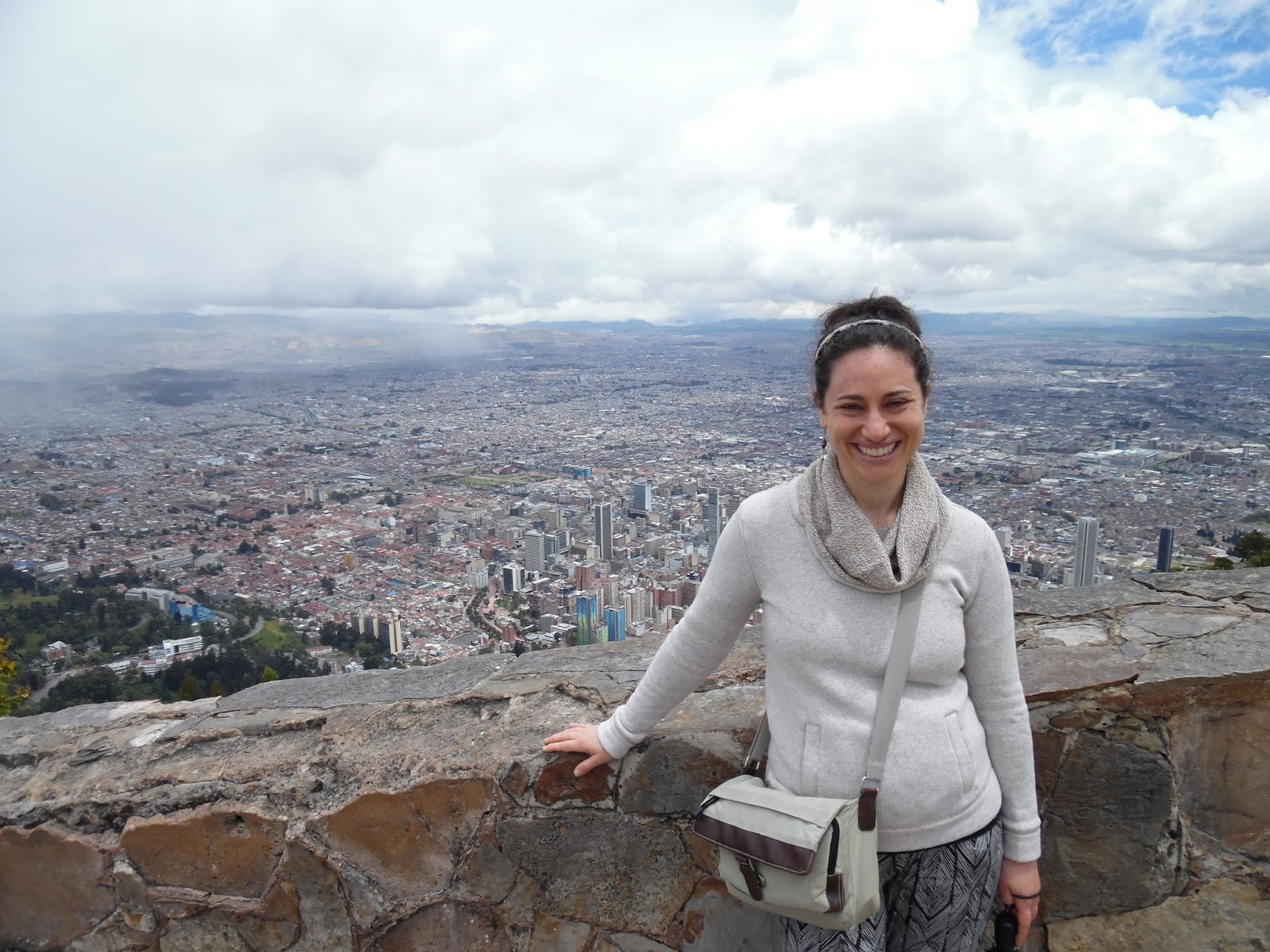
After a day of travel the TGC Colombia cohort arrived in Bogota at the beautiful Sofitel Hotel. The hotel is located in a commercial district of Bogota called la Zona Rosa.
 |
| Our group at the airport in Houston en route to Bogota |
|
|
|
|
|
|
 |
| Our arrival welcome at Bogota |
Following a beautiful breakfast which included a fruit salad of guava, passion fruit and jugo de lulo we received a two hour crash course in the political history of Colombia. I will do my best to sum up the history here as I believe this background helps contextualize the current successes and struggles in Colombia.
There were two pre Colombian civilizations in Colombia prior to the European explorers arriving on the South American continent. Tayronas was the settlement on the Caribbean coast and Muiscas were in the highlands. The first city, Cartagena was founded in 1533 by European explorers who were motivated to find gold in this new land. As the years went by, more and more Europeans settled in the capital of Colombia, Bogota which was established in 1538.
Fast forward 200 years...Simon Bolivar traveled to Europe and spent time learning about Enlightenment movement, the French Revolution and the new French document stating the rights of man. The French Revolution inspired Bolivar to start a revolution of his own in Latin America. Bolívar began his campaign for independence in 1808 and established an organized national congress within three years. Colombia was given its independence on July 20, 1810 with Simon Bolivar serving as its president from 1819 until 1830. Through the liberation of Colombia and the establishment of an independent government, Bolivar established the oldest democracy in Latin America.
In 1886 Rafael Nunez created the first Colombian constitution which was later modified in 1991. In 1890 Catholicism became the official religion of Colombia and the church was granted equal power to dictate law along with the federal government.
In the early 1920s, laborers in Colombia began to demand better pay and better hours. The workers of the banana plantations in Colombia went on strike in
December 1928. They demanded written contracts, eight-hour work days,
six-day work weeks and the elimination of food coupons. The strike
turned into the largest labor movement ever witnessed in the country
until then. In 1928 the army was sent to Santa Marta to stop the strike. This movement ended in violence with anywhere between 800 to 3,000 people killed, their bodies thrown into the sea. Guerilla movements rose out of this massacre with people demanding social change for the lower class of Colombia.
In the 1940s, liberal leader Jorge Gaitan began to rise to power. He was the favorite of the people and worked to secure the rights of the working class. He was favored to win the presidential election but was assassinated on April 9, 1948. His assassination led to massive uprisings by the people called el Bogotazo. The death of Gaitan resulted in a struggle for power between the liberal and conservative parties and triggered a period in the history of Colombia known as "The Violence" that lasted until 1958, and where much of the civil conflict in Colombia stems from today. From this unrest grew various guerilla factions such as M19 and the Frente Nacional. Their original intention was to promote social change for working Colombians but as their power grew they turned to the drug trade to fund their military power.
From 1953 to 1957 Rojas Pinilla was in power having overthrown the previous government. Rojas enacted legislation that gave women equal rights to vote. He
introduced the television and constructed several hospitals,
universities and the National Astronomic Observatory. He was also a
strong supporter of public works and infrastructure, promoting and
conducting projects such as the Atlantic railway. He was subsequently ousted from office by a military coup.
Since the 1960s Colombia has had several presidents who have worked to establish control throughout Colombia. The current president, Juan Santos, is trying to establish peace negotiations with leaders of the FARC and other guerilla factions. Political unrest combined with drug trafficking, poverty and the remote nature of some of Colombia's communities have led to violence throughout the country. However, in the past twenty years there have been incredible changes in Colombia.
The government began an aggressive campaign to ensure the security of its people by cracking down on guerilla groups as well as establishing peace processes. After almost four years of peace negotiations, the Colombian state and
the FARC have agreed to a bilateral and “definitive” ceasefire which was signed in Bogota today, July 20, 2016. President Santos has also began a new initiative entitled Peace, Equity and Education. By 2025 he envisions a conflict free Colombia through the eradication of extreme poverty and investment in education.
That brings me to today. As a visitor to Bogota I feel the energy, joy and pride people have in their country and a sense of optimism that things are getting better. As I travel throughout the country I hope to get a better sense of how people see their communities improving and the part they play in Colombia's forward movement.